
What is the MVC Pattern and Why Do Companies Still Use It?
If you've been browsing job boards lately, you've probably noticed ASP.NET MVC showing up in more listings than you'd expect. Here's why it still matters, and what it actually means for your career.
First things first: what even is MVC?
MVC stands for Model-View-Controller. It's a design pattern, a way of organizing code, that separates an application into three distinct parts, each with a clear responsibility.
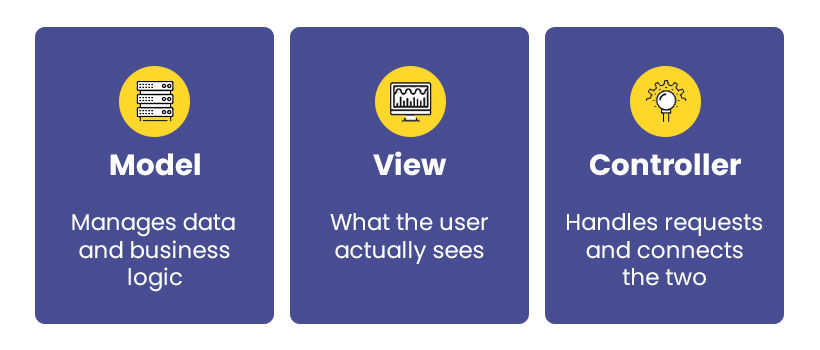
Think of it like a restaurant. The Model is the kitchen. It holds all the data and knows how to prepare things. The View is the dining area. It's what the customer experiences. The Controller is the waiter, taking orders from the front, passing them to the kitchen, and bringing back the results.
Before patterns like MVC became popular, developers would often mix HTML, database queries, and business logic into a single messy file. That worked fine for small projects, but the moment a team grew or requirements changed, things fell apart fast.
So why do enterprises still use it?
This is the question fresh developers tend to ask when they first discover MVC. If it's been around since the late 1970s (yes, really), why hasn't something newer replaced it entirely?
The honest answer: because it works, and it works at scale.
Big companies like banks, government agencies, logistics firms, and BPOs have built enormous systems on ASP.NET MVC. The codebase is familiar to large developer teams, it integrates cleanly with Microsoft's ecosystem, and it has decades of community support behind it. You don't rewrite a system that handles millions of transactions a day just because something newer came along.
The MVC pattern doesn't live in just one framework. But ASP.NET MVC, Microsoft's C# implementation, is the version most commonly used in enterprise environments across the Philippines and Southeast Asia. Companies in these industries tend to rely on it heavily:
Banking and finance.
Healthcare systems.
Government portals.
BPO platforms.
Retail and e-Commerce.
Logistics and supply chain.
If you're aiming for an internship or entry-level role at any mid-to-large company in these sectors, there's a very good chance MVC knowledge will come up, either in the interview or on day one.
What makes MVC click for beginners
One underrated thing about learning MVC early is that it teaches you to think in terms of structure. When you're new to coding, it's easy to write code that does the job, but becomes impossible to read a week later. MVC forces good habits from the start. Your data logic stays in one place, your interface in another, and the connection between them stays clean.
This kind of thinking transfers. React, Vue, Angular, and even newer frameworks borrow heavily from the same separation-of-concerns principle that MVC introduced. Learn MVC well, and you'll find modern frameworks easier to grasp when you get to them.
Most entry-level web development roles will ask you to build or maintain CRUD applications — systems that Create, Read, Update, and Delete data. Think inventory trackers, employee databases, customer portals. MVC is well-suited to this kind of work.
Being able to walk into an interview and say "I've built a CRUD application using ASP.NET MVC" is a concrete, demonstrable thing. It's not just a concept you've heard of. It's something you can show in a portfolio.
A note on learning MVC the right way
Reading about MVC and building something with MVC are two completely different experiences. A lot of developers, including seasoned ones, will tell you that the pattern only really clicked once they sat down and built something from scratch. Controllers, routing, Razor views, form validation: these things make a lot more sense when you're the one writing them.
That's why hands-on training matters. Not just watching someone else code, but building your own project, making your own mistakes, and figuring out why something broke. That's where real learning happens.
Invictus Training Solutions offers a 5-day beginner-friendly ASP.NET MVC course designed specifically for students and fresh graduates, complete with a hands-on CRUD project you can add to your portfolio. Click below to find more information about the training.


Comments